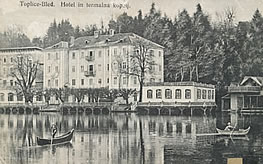
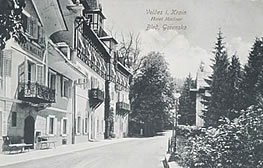
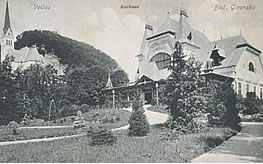
Pilgrims who worshipped St. Mary on the island may be regarded as the first visitors to Bled. As well as performing their Christian duties, they marveled at the beauty of the place and attracted more and more pilgrims by spreading word about it. In addition to ordinary people, Bled was also visited by the nobility. Janez Vajkard Valvasor, a local nobleman and polyhistor of Carniola, wrote his book The Glory of the Duchy of Carniola in 1689, in which, among other things, he describes the thermal springs of Bled. Weidmann, the administrator of the castle, due to an influx of visitors in search of health remedies whose needs he had to cater for, sought to fill in the thermal springs, but was not allowed to. People kept coming, bathing and, as Valvasor states, were healed.
Subsequently, there was another serious threat to the development of Bled, posed by Ignac Novak, a later administrator of the castle. Between 1782 and 1787 he often suggested that the lake should be drained so that the clay from the lake bed could be used as a raw material for a brickworks, however, the Carniola Regional Assembly turned down Novak’s proposal. In 1822, the springs were given a wooden cover. As the water was not especially warm (23°C), Bled was increasingly visited by those who did not care for its healing properties, but instead simply marveled at the idyllic beauty of the area.
The eminent English naturalist Sir Humphrey Davy described Bled as ‘the most beautiful place he had ever seen in Europe’. At the time of the Awakening of the National Consciousness, young and old flocked to Bled in search of the temple of the Slavic goddess Živa and the shadow of her beautiful priestess Bogomila.
Between the two World Wars, Bled remained the most cosmopolitan resort in Yugoslavia and the summer residence of the Karađorđević royal family. It was frequented by numerous domestic and foreign visitors. During summer months, it became the center of political and diplomatic life.
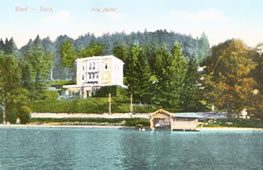
After World War II, the tourist tradition was continued, and most of the infrastructure which had come into Slovenian ownership was renovated. As President Tito had a residence at Vila Bled, the area was visited by numerous domestic and foreign statesmen, politicians and figures from the world of culture. Vila Bled is today a high-quality hotel living up to the expectations of the most demanding guests.
Arnold Rikli is not forgotten. To mark the 50th anniversary of his work, his supporters constructed a monument on Straža, which remains visible today. The Bled Tourist Association erected a monument in the Health Park for the 125th anniversary of his work. His methods, complemented by modern therapeutic techniques, remain in use at the Golf Hotel.
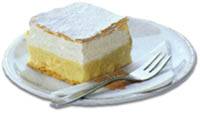
Cream Cakes (Kremne rezine)
Cream cakes, known to Bled for decades, are in fact the symbol of Bled. Ištvan Lukačevič, the former manager of the Hotel Park patisserie, tested recipes for many years before he finally succeeded. Over the last 40 years they have sold as many as 7 million cream cakes. It is a golden crispy crust made from butter dough (mixed with butter, not margarine), a delicious vanilla cream of exactly the right consistency (with exactly the right amount of flour - if there is too much the cakes are no good, if too little, they collapse after cutting), topped with whipped cream and a crispy layer of butter dough and finally, last but not least, a good dusting of icing sugar.