 |
 |
 |
Dunluce Castle
|
|
|
|
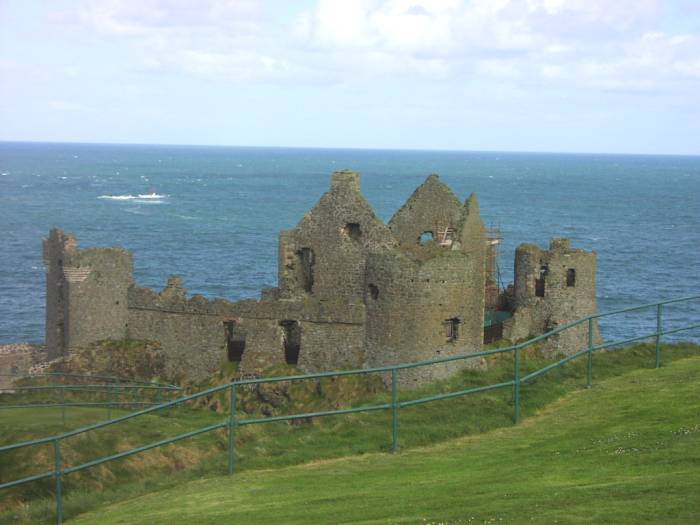
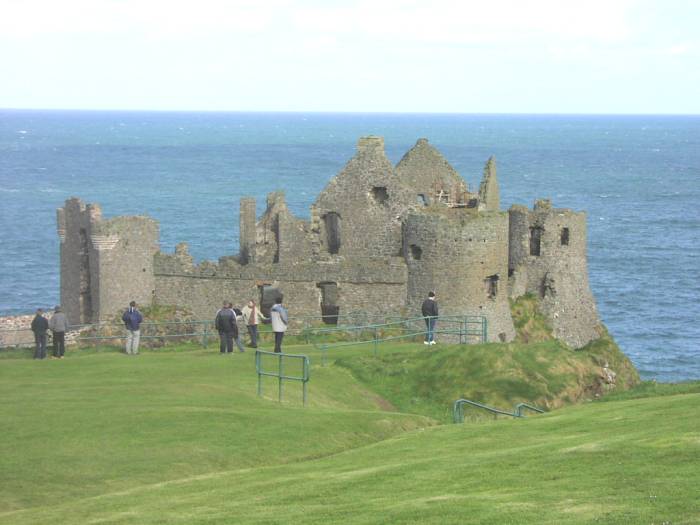
There are references to Sorley Boy McDonnell's many political differences of opinion, much to the displeasure of the Queen Elizabeth I. Sir John Perrott took the castle on instructions from Queen Elizabeth in 1584. The castle has seen lots of sieges and battles in its years. Sorley Boy eventually went to live in Dunaneenie and the castle came into the possession of his son Randal McDonnell. Randall set about restoring the castle and built a lavish manor house within the castle walls. He married the widow Lady Katherine Manners, daughter of the Earl of Rutland. Her husband George Villiers, the Marquess of Buckingham, was shot in Portsmouth by a disgruntled naval officer called John Fenton. Dunluce Castle became their residence. An inventory dating from this period shows that the castle was indeed a fine residence. The Earl and Countess of Antrim frequented the royal court in London and acquired many of their possessions there. There were said to have been tapestries and exquisite curtains including a set which had belonged to Cardinal Wolsley at Hampton Court. The inventory lists six sets of chairs of state, which would have been placed under an elaborate canopy. Sixty other elaborately upholstered chairs and stools were at the castle including a library of books. There were saddles worked with gold and silver, finely inlaid cabinets and valuable objects such as telescopes, celestial and terrestrial globes. The most valuable listings were the priest's vestments. The Countess is credited with establishing St. Cuthbert's Church (nearby to the castle) with it's thatched roof and is recorded as having a lavish interior which included the signs of the zodiac painted in the ceiling plaster. A village grew up around the castle with its own customs house at Portballintrae. Merchants settled there and it became a thriving focus of commerce. Evidence to this can be found in the many headstones within the old church graveyard. In 1639, while the second Earl and his Countess were there, part of the castle, including the kitchens, fell into the sea; seven cooks went with the kitchens, but an itinerant cobbler was said to have survived in a corner of the vanished room. The 1641 rebellion saw the castle under siege by an Irish army and the surrounding village burnt. The castle held out under the command of Captain Digsby and was relieved by the Earl. Most of the Scottish settlers and merchants escaped to Scotland before the village was destroyed. General Munro arrived in 1642 with a large army, some thousand foot soldiers, two troops of cavalry and field guns. He is said to have arrested and imprisoned the Earl in Carrickfergus, ransacked Dunluce and another castle belonging to the Earl as well as burning Glenarm.. The Earl re-occupied Dunluce Castle after 1666 and lived there until his death in 1683. Oliver Plunkett, the Archbishop of Armagh who had at the time been recently canonized, was a visitor during this period and described it as a 'palace washed on all sides by the sea'. After the Battle of the Boyne in 1690, which led to the impoverishment of the McDonnells because they had adhered to the cause of James II, Dunluce Castle was abandoned and Ballymagarry House, nearby, became the Earls of Antrim's main residence. Ballymagarry was destroyed by a fire in 1745 after which Glenarm Castle became the principal seat of the Earl of Antrim. The dark hollow on the very right of the castle was where the kitchen used to be. Dunluce Castle is thought by many to be the most picturesque and romantic of Irish castles. In 1928, the castle was given to the Northern Ireland Government by the Earl of Antrim to be preserved as a National Monument. |