 |
 |
Burren Hills
|
|
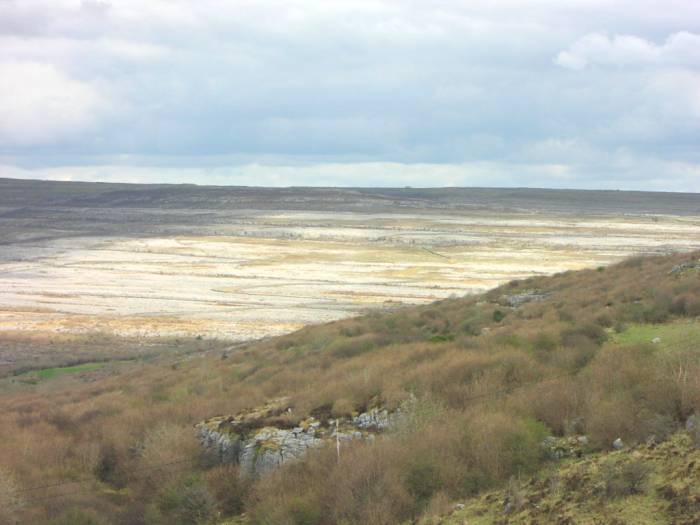
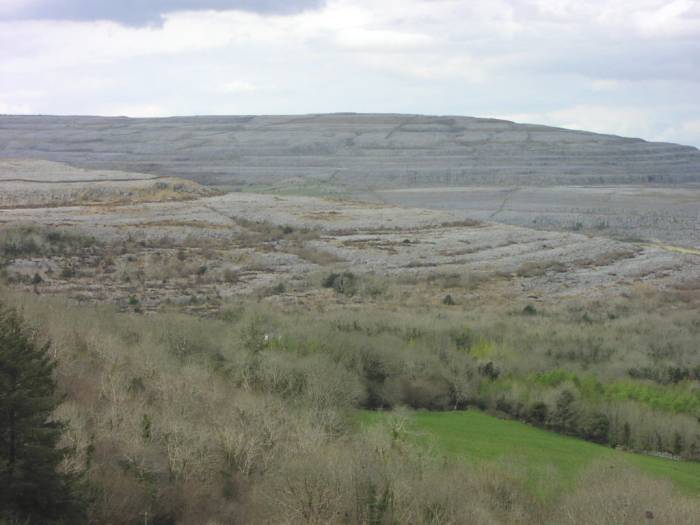
The grey limestone hills of the Burren in County Clare appear from the distance to be devoid of vegetation (the name Burren comes from the Irish name An Bhoireann, meaning 'rocky place'), but actually support a profusion of wild flowers growing in the narrow fissures of the limestone.
Geologically the Burren consists of a sequence of massively bedded Carboniferous limestone, dipping gently to the south. Individual rock layers form pavements of limestone which give a terraced effect where the hills slope eastward to the adjoining lowlands. The landform are from the glacial erosion during the Quaternary ice ages, as well as to the effects of limestone dissolution. Drainage is almost entirely underground and there are well developed cave systems. Fluctuating water tables in the porous limestone do, however, create turloughs (temporary lakes) which are a feature of the area.
From a botanical point of view the Burren is one of the most fascinating regions of Western Europe. Many of the plants found in the Burren occur nowhere else in Ireland and the combination of plants usually found in Arctic regions or on high mountains with other species from southern Europe is remarkable. The Burren flora includes the Maidenhair Fern (a warm temperate plant), a Mediterranean orchid, Mountain Aven (a true arctic-alpine plant), Spring Gentian (an alpine plant), Hoary Rock-Rose, Bloody Cranesbill and Dark Red Helleborine. Late May and early June is the best time to see the flora of the Burren in full glory.
The fauna is less spectacular but also interesting. Insects include the Burren Green Moth (found nowhere else in Britain and Ireland) and the Pearl Bordered Fritillary butterfly. There are also many Pine Martens in the Burren, a few of which have been translocated to Killarney National Park in the past.
Whilst the Burren may appear inhospitable to human activities, numerous monuments and archaeological sites chronicle human occupation of the area for at least 5,000 years. There are neolithic tombs (including portal tombs and wedge shaped gallery graves), a variety of stone ring-forts and several early Christian churches, oratories and monastic sites with carved crosses and inscribed stones.