|
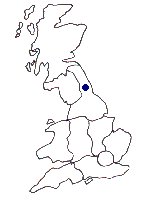
YORK The ancient Viking capital
|
|
| The Romans
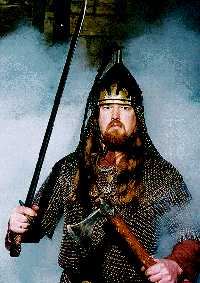
England was invaded in 43 AD by 4 Roman Legions. In 71 AD the Roman 9th Legion arrived in what is now York but was then called Eboracum. The locals, who were nomadic tribes called brigantines, didn't stand a chance. York lies between two rivers the river Foss and the River Ouse. The Romans built their fortress on the north side of the River Ouse. Lying beneath what is now York Minster. The fortress housed about 6000 men. At the southwest side of the river Ouse, eventually a civilian town grew up. York then became the capital of northern England. The Romans spent the next thirty years attempting to tame the 'wild barbarians' of northern England and Scotland! (see Hadrian's Wall) In order to protect their toga-clad rears, the legions of Lincoln, Wroxeter and Gloucester were moved forward to York, Chester and Caerleon, these points becoming the effective limits of the 'civil zone'. The Romans found Britain divided into little states or kingdoms, each under a native king. The Romans used these native kings and nobles to keep control over each state or canton - the native Bricantes tribes ruling most of the canton now called Yorkshire came under the control of the legionary fortress of Eburacum, thought to mean 'a place of yew trees' (York). Britain underwent a remarkable change as the Romanization of the 'civil zone' proceeded. Order and discipline replaced prehistoric disorder. Towns, houses and political institutions rapidly appeared. The 'great unwashed' were even introduced to the social institution of public baths and the country settled down to be as Roman as it could. Such was its importance with its fine building, its baths, temples amphitheatre and forum, that Emperors came there to stay. Some stayed longer than others, as two of them died here. Septemus Severus died in York in 211 AD. Constantius Clorus died there in 306 AD. His son Constantine was proclaimed emperor in York. He was the first emperor to allow Christianity into the country and later became Constantine the Great. His statue can now be seen outside the south transept of York Minster. York was changed into a thriving town with goods traveling from all over Europe and beyond. The imports allow the building of villas some with beautifully decorated mosaic floors. A lot of the finds from this period of history can be found in the Yorkshire museum. The Romans left York 388 AD to 400 AD and eventually they quit Britain by 410 AD. Leaving the people to now fend for themselves against the next invaders, the Saxons. When the Romans left in AD 410, Britain again reverted to a series of little Celtic states enjoying various degrees of Romanisation. A time of temporary but relative prosperity - yippee! no Roman taxes to pay! The 'wild barbarians' that the Romans had failed to subdue in the North, namely the Irish, Picts and Scots, dropped in from time to time to plunder this wealth. Time for some protection - some bodyguards - the Saxons. The Saxons The Saxons, at first brought in as mercenaries, liked the place and the people so much that they decided to stay, bringing their own Germanic culture and social system to the area. The Saxon system had no need of the towns or roads of Roman Britain and York's influence declined. We know very little about the Saxons. Not just York, but England descended into a period known as the dark ages after the Romans had left. "They were that busy fighting that they didn't find the time for writing." says Norma. Christianity all but died out in this time, until the year 625 AD. England was now spilt into separate kingdoms. York became the capital of Northumbria changing its name from Eboracum to Eoforwic. King Edwin of Northumbria married a Christian princess from Kent. Ethelberger brought with her, her own priest called Paul Iness. Between the two of them they convinced Edwin to throw away his false gods and idols and take up the Christian faith. He had a small wooden church built on the site of the present York Minster. On Easter day 627 AD he was baptized. Once again Christianity prevailed over this area. The Vikings Time went by with fighting going on between the different kings until the year 866 AD when Danish Viking invaders ransacked the city and changed it's name to Jorvick. A Viking kingdom which stretched from the River Tees in the north to the River Thames in the south, was under Danish control (Danelaw). By AD 1000 York had expanded and had some 8,000 inhabitants. The influence of the Vikings is apparent in York and throughout Yorkshire today in many street and place names - Stonegate, Swinegate, village names ending in 'by' and 'thorpe'. Danish territorial divisions survive in the three Ridings ( Thirdings) of Yorkshire. The Vikings intermarried and settled down bringing a different way of life to the area, but not without spilling a lot of blood. The last Viking king of Yorvik was Eric Blood Axe. In 1066 AD England was now ruled by a single King. Yet in that one year we were to see 3 different Kings of England. Edward the Confessor died in January and left the crown to Harold of England. Harold’s half brother Tostic joined forces with a Viking called Harold Hardroder to take the crown. A bloody battle was fought, just a few miles out of York, at a place called Stamford bridge on September 25th of that same year. Hardroder and Tostic were both killed there, leaving king Harold the undisputed king of England, or so he thought. The Normans Harold got a message to say a greater force than his had landed down south. Only 3 weeks later, on October 14, he fought the battle that was to change the face of British history. This was the battle of Hastings. His opponent was William of Normandy. Harold lost the battle and on Christmas day 1066, William was crowned king of England. That was the last time England was ever conquered. The
Norman invasion of 1066 changed the face of York and Britain to one
easily recognizable today. New scientific thought and religious freedom of the 16th and 17th centuries led through to technical advances based on iron, steel and powered machinery. Ultimately this took us to the Industrial Revolution of the 18th century. York played a significant role in this as a major manufacturer of railway rolling stock. The National Railway Museum houses the world's largest collection of engines and carriages in it's three unique galleries. |
 Saxon and Viking buildings were mostly
wooden and few of them stood above tree level. The Normans however
brought with them a genius for architecture. They possessed
building skills which in their day would have amounted to an industrial
revolution. Stone churches replaced wooden structures, castles and
castle mounds like York's Clifford's Tower demonstrated the Norman
desire for order, unity and good government. Surely the finest
example is the 800 year old York Minster, the largest Gothic cathedral
in Northern Europe.
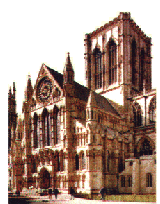
Saxon and Viking buildings were mostly
wooden and few of them stood above tree level. The Normans however
brought with them a genius for architecture. They possessed
building skills which in their day would have amounted to an industrial
revolution. Stone churches replaced wooden structures, castles and
castle mounds like York's Clifford's Tower demonstrated the Norman
desire for order, unity and good government. Surely the finest
example is the 800 year old York Minster, the largest Gothic cathedral
in Northern Europe.